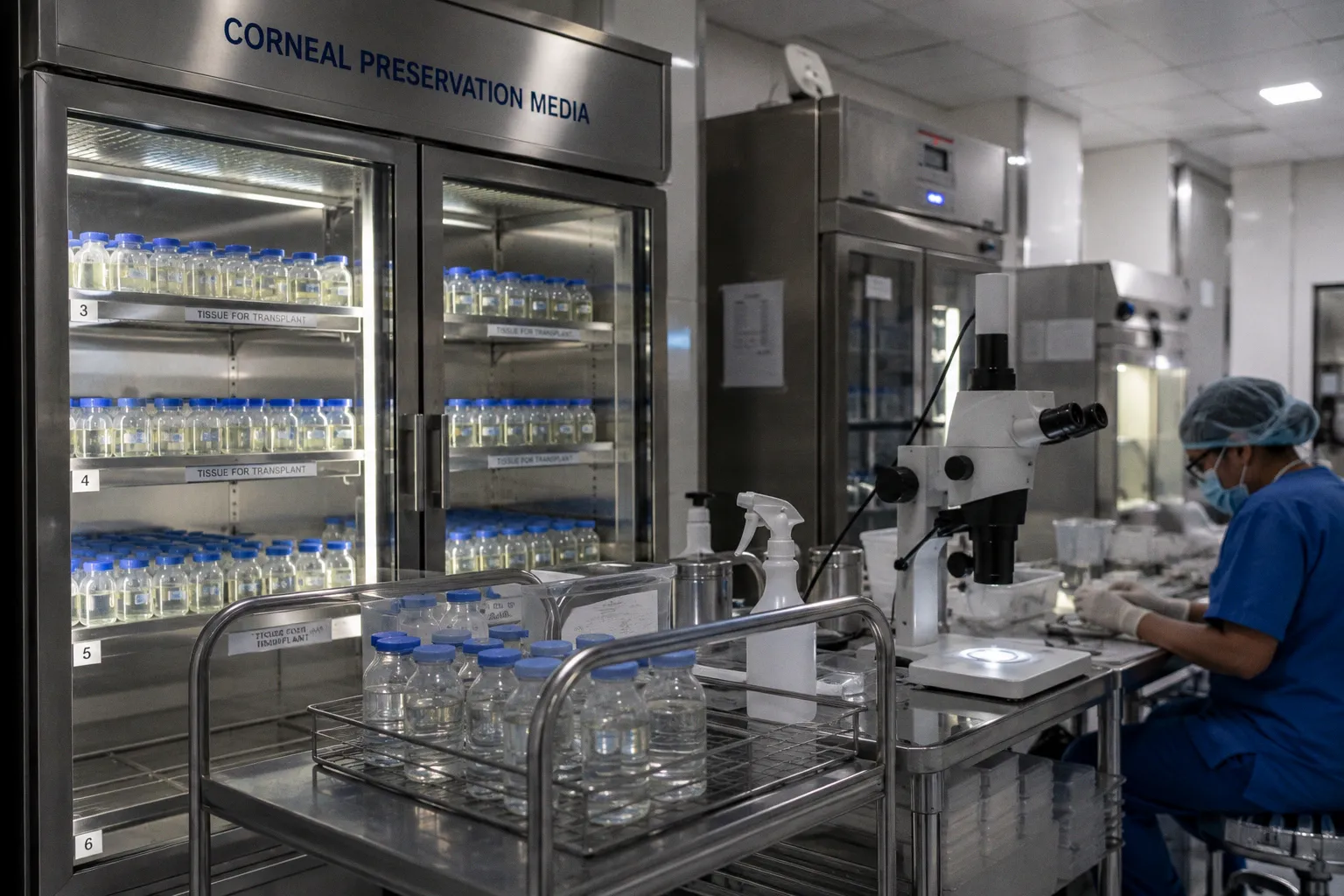
The immediate operational issue is not awareness alone: public health and clinical leaders identified an acute deficit in graft-ready donor corneas. For ocular biobanking, that places procurement throughput upstream of every later stage of transplantation and research coordination.
Awareness is being used to increase procurement capacity
The Chennai initiative is structured around public mobilisation. Rotary Rajan Eye Bank is encouraging people to pledge their eyes after death, with the stated objective of increasing the number of potential donors. The campaign also involved public health officials, clinical leaders, students, and community participants.
That distinction matters. A pledge is not yet a recovered cornea, and a recovered cornea is not automatically graft-ready tissue. Between those points sit family notification, post-mortem retrieval, eligibility screening, tissue handling, and viability assessment. The available reporting does not provide conversion rates between pledges and usable grafts, so the campaign’s measurable effect on tissue throughput remains unestablished.
The reported deficit is specifically described in terms of donor corneas suitable for grafting. That is a more operationally relevant metric than pledge volume alone. It points to a constraint in the supply chain: the system needs not only more commitments, but also reliable activation and processing after death.
Retrieval protocols remain a separate control point
A programme at District Hospital Longleng addressed the clinical side of the same pipeline. Healthcare leaders reviewed post-mortem corneal retrieval and donor-screening criteria under the National Programme for Control of Blindness and Visual Impairment framework.
The session covered operational guidance for enucleation, tissue-viability windows, and infectious-disease exclusions. These are the variables that determine whether a potential donation can progress through the bank’s acceptance workflow. They also define the data that must accompany a tissue record: retrieval timing, screening status, and the factors used to determine eligibility.
This is where awareness activity meets biobanking infrastructure. A larger donor pool increases the input queue, but without consistent retrieval and screening procedures it does not guarantee a corresponding increase in usable tissue. Conversely, technical sensitisation without sufficient public pledges leaves the procurement pipeline under-supplied.
What to track after the pledges
The current reports establish two linked interventions: Rotary Rajan Eye Bank is expanding public awareness in Chennai, while healthcare teams elsewhere are reviewing retrieval and screening protocols. They do not establish how many new pledges were recorded, how many corneas were recovered, or whether graft-ready availability has improved.
The practical indicators to watch are therefore straightforward: pledge-to-retrieval conversion, adherence to tissue-viability windows, screening exclusions, and the final proportion of recovered tissue accepted for grafting. Those metrics would show whether the awareness drive is reducing the supply gap or simply increasing the first-stage enrolment count.
On the available evidence, the campaign addresses a documented procurement bottleneck, but its downstream effect remains unmeasured. For eye banks and vision researchers, the relevant outcome is not campaign reach. It is validated tissue entering the usable supply chain.