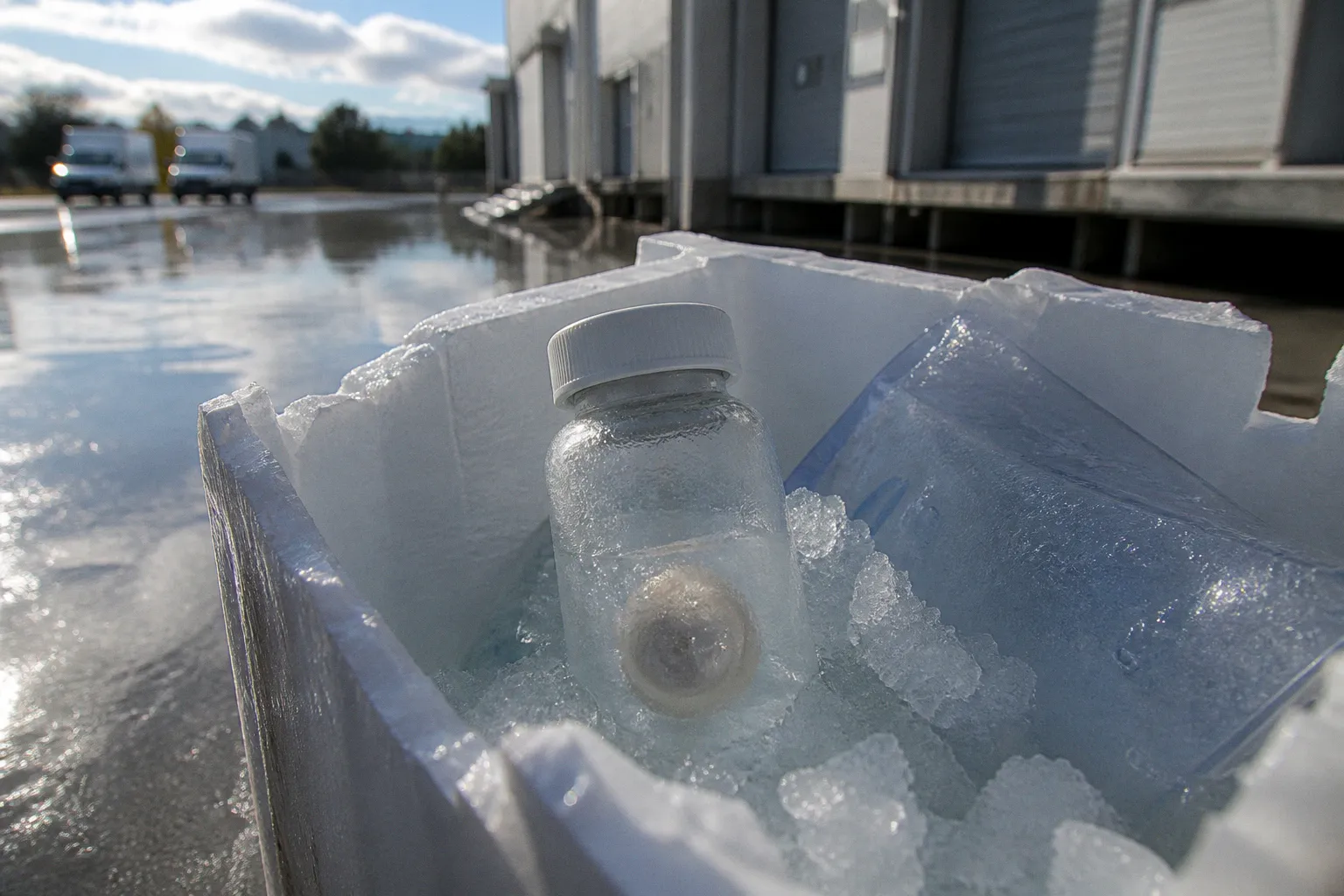
Each event is logged, or it is not. The cumulative variance across that sequence, measured against the 2 °C to 8 °C hypothermic window mandated by Eye Bank Association of America (EBAA) standards, decides whether the endothelium survives intact or whether the tissue drifts past the eligibility threshold for downstream assays. Donor eye cold chain temperature excursion is not a peripheral quality concern; it is the central variable governing whether a research-grade specimen delivers usable molecular data or becomes a sunk procurement cost.
The tissue arrives at the biorepository with a thermal history already written — in logger memory where the procurement chain was rigorous, in silence where it was not. For laboratories that depend on transcriptomic yield from post-mortem ocular tissue, that history is the difference between a sequencing run that resolves cell-type-specific signatures and one that returns degraded RNA profiles indistinguishable from autolytic background.
The Mechanics of Hypothermic Storage and Endothelial Stability
Hypothermic storage of donor corneas operates within a narrow thermal band: 2 °C to 8 °C, with most eye banks targeting 2 °C to 6 °C or a steady 4 °C. Within this range, endothelial cell metabolism slows sufficiently to extend tissue viability to a maximum of fourteen days from procurement. The lower bound is not arbitrary; it is set just above the freezing point of corneal storage media, beyond which ice crystal nucleation causes irreversible cytoskeletal damage.
Organ culture preservation offers a wider operational envelope: 31 °C to 37 °C, sustained for up to four weeks. This modality supports longer storage windows but introduces its own logistical requirements — incubator-grade temperature control, sterility monitoring, and media exchanges that the cold-storage pathway does not.
The shift from moist chamber preservation at 2–6 °C, introduced in 1935, to hypothermic storage in tissue culture medium at 2–6 °C in 1974 marked the first major extension of donor cornea viability. The subsequent introduction of organ culture storage at 31–37 °C in 1976 added a second operational track. Each advance widened the procurement-to-graft interval; none of them relaxed the underlying thermal contract.
| Parameter | Hypothermic Storage | Organ Culture |
|---|---|---|
| Temperature range | 2–8 °C | 31–37 °C |
| Maximum storage duration | ~14 days | ~28 days |
| Equipment requirement | Refrigerated transport | Incubator-grade |
| Endothelial assessment | Specular microscopy pre-shipment | Reversible swelling; post-storage deturgescence |
| Dominant failure direction | Freezing (downward) | Warming and contamination (upward) |
| Cold-chain risk profile | Narrow margin to phase transition | Narrow margin to microbial proliferation |
The donor eye cold chain temperature excursion profile differs fundamentally between the two modalities. A hypothermic shipment fails downward — toward ice nucleation. An organ culture shipment fails upward — toward accelerated metabolic depletion and microbial ingress.
A 2 °C excursion below the storage floor is not a deviation to be logged and forgiven. In most cases it is the end of the tissue's clinical or research eligibility.
Anatomy of a Cold Chain Failure: From Packing Errors to Freezing Injury
The most documented failure mode in donor cornea cold transport is not warming — it is inadvertent freezing. Packing protocols that pre-cool gel packs to –40 °C, or that insert excessive gel pack mass into the secondary container, drive the internal tissue chamber toward 0 °C within minutes of sealing. The endpoint is not gradual cooling; it is acute phase transition across the media.
Freezing whole donor corneas produces severe endothelial cell loss through two simultaneous mechanisms: intracellular ice crystal formation, which physically disrupts the cytoskeleton and organelle membranes, and solution effect injury, in which extracellular ice concentrates solutes and osmotically dehydrates the remaining liquid phase. Neither mechanism is recoverable. Tissue exposed to sub-zero temperatures during transport is typically withdrawn from both clinical and research pipelines.
The packing error is rarely one of intent. It is one of unvalidated protocol transfer — a courier trained for vaccine or biologic shipments, applying the same pre-conditioning logic to a tissue whose thermal floor sits within two degrees of freezing rather than twenty. The EBAA prohibition against freezing is operationally specific; commercial cold-chain providers do not always carry that specification in their standard operating procedures, and the receiving laboratory absorbs the consequence.
The contributing variables stack:
- Pre-conditioning temperature of gel packs before pack-out (–40 °C baseline risk)
- Number of gel packs per shipping container relative to payload mass
- Ambient temperature exposure during packing (loading dock duration)
- Transit time relative to pack thermal mass
- Secondary insulation R-value and container wall thickness
- Receiver-side delay between delivery and refrigerator placement
- Orientation of tissue vial relative to direct gel pack contact
Each variable is tunable. Few are routinely measured at the resolution that matters.
Molecular Consequences of Temperature Excursions on Corneal Tissue
Temperature excursions that fall short of freezing still carry a measurable molecular cost. Cold storage of donor corneas for ten days has been documented to alter the expression of over 3,300 genes in corneal endothelial cells relative to immediate preservation — 1,264 upregulated, 2,058 downregulated. The shift is not noise; it reflects a coordinated cellular response to hypothermic and oxidative stress that reshapes the transcriptome available to downstream sequencing assays.
Below the transcriptomic layer, the structural consequences accumulate more quietly. Hypothermic storage induces breakdown of the actin cytoskeleton in endothelial cells, disassembly of microtubules, and disruption of tight junction proteins — including ZO-1 — through oxidative stress signaling. These changes do not require a temperature excursion; they are the baseline trajectory of cold-stored tissue. Excursions outside the 2–8 °C window accelerate the trajectory and shift the endpoint.
For biorepositories distributing post-mortem ocular tissue to vision research laboratories, the implication is direct. Research-grade specimens are routinely held to less rigorous thermal documentation than clinical grafts, despite carrying the same molecular fragility. A donor globe whose transit log shows a two-hour ambient exposure at a courier hub may still arrive at the receiving laboratory within the nominal storage window — but the tissue it delivers is no longer the tissue it was at procurement. For transcriptomic assays, particularly those depending on intact endothelial mRNA, degradation kinetics compound across the recovery-to-instrument arc, and the final yield reflects the weakest node in the chain rather than the tissue's intrinsic potential.
The cold chain does not end at the receiving bank. It ends at the sequencer, the microscope, or the assay plate — whichever node consumes the tissue last.
Logistical Vulnerabilities in Ocular Biorepository Transport
Ocular biorepository cold chain logistics operate across variable infrastructure. A domestic shipment between two EBAA-accredited banks follows a relatively predictable thermal profile, with calibrated gel packs, validated containers, and continuous data logging as standard. International shipments, multi-leg courier networks, and transport to academic laboratories in regions without formal eye bank accreditation introduce handoffs that the original packing protocol did not anticipate.
Whole globe donor recovery adds further complexity. Unlike a precut corneal graft in storage media, a whole globe is recovered in a moist chamber, transported at hypothermic temperatures without media immersion, and must reach the processing laboratory within a tighter viability window. The transport vessel is simpler — typically a sealed container with saline-moistened gauze — but the thermal margin is narrower and the consequences of warming are more immediate.
No universal global consensus currently governs real-time continuous data logger requirements for non-transplant research donor eyes across all biorepositories. Clinical-grade shipments within established accreditation networks operate under defined logging protocols. Research shipments, particularly those crossing borders or moving to non-academic recipients, frequently operate under the receiving institution's own thermal documentation — or under none at all. Donor globe transport temperature monitoring in the research setting remains a function of individual bank discipline rather than enforced standard.
The high-risk failure points cluster at handoff nodes:
- Domestic courier sort facilities without temperature-controlled zones
- International customs holds in unrefrigerated inspection areas
- Receiving laboratory intake queues without immediate refrigerator capacity
- Weekend or holiday dispatch windows with reduced staffing at receiving banks
- Shared shipping containers combining clinical and research specimens with incompatible thermal profiles
- Last-mile courier substitution where a contracted specialty courier is replaced by a generalist
The pattern is consistent. The failure is not the cold chain itself but the assumptions built into it — assumptions about ambient conditions, about handoff duration, about courier training, about receiver readiness.
Mitigating Thermal Risks in Research-Grade Ocular Specimen Handling
The mitigation set is mature in clinical eye banking and uneven in research distribution. Donor eye cold chain temperature excursion events are reducible through layered controls, most of which are already validated somewhere in the supply chain.
Validated shipping containers with documented thermal performance curves — measured against ambient profiles from –10 °C to +35 °C — remove much of the packing variance. Pre-qualified gel packs, conditioned to a narrow temperature band rather than frozen to a generic baseline, eliminate the most common pathway to accidental freezing. Containers that have been validated against the EBAA prohibition against sub-zero exposure carry operational weight that ad hoc foam boxes do not.
Continuous data loggers placed inside the tissue container, set to log at one- or five-minute intervals, generate a thermal record that the receiving laboratory can audit before processing. Where the clinical supply chain treats this as standard, the research supply chain treats it as exceptional. Closing that gap is the single highest-yield operational intervention available to biorepositories distributing non-transplant ocular tissue.
Pre-conditioning protocols — holding gel packs until their internal temperature equilibrates to a documented setpoint, then validating against a reference probe before packing — reduce packing variance to a measurable residual. Receiver-side verification, in which the receiving bank logs the tissue temperature at intake and confirms logger continuity, closes the loop and surfaces excursions that occurred in transit.
Chain-of-custody documentation that ties each handoff to a logged thermal event transforms the cold chain from an inferred property into an audited one. For research biorepositories whose downstream users depend on transcriptomic yield and clean histological architecture, the audit is not administrative overhead — it is the precondition for reproducible molecular data and defensible publication.
Closing Assessment
The cold chain for donor ocular tissue is a thermal contract between recovery and assay, written in degrees and minutes. The contract is well understood at its endpoints and loosely enforced in its middle. Donor eye cold chain temperature excursion events occur not because the protocols are unknown but because the protocols are unevenly applied across the courier, customs, and receiving nodes that sit between the eye bank and the research laboratory.
For biorepositories serving the vision research community, the path forward is operational rather than scientific. Validated containers, conditioned gel packs, continuous logging, and audited chain-of-custody already exist as standard practice in the clinical supply chain. Extending that standard to research-grade shipments is not a research question. It is an infrastructure decision, and it is the decision that determines whether a recovered donor globe delivers its full molecular payload or only the fragments that survive an undocumented thermal history.